


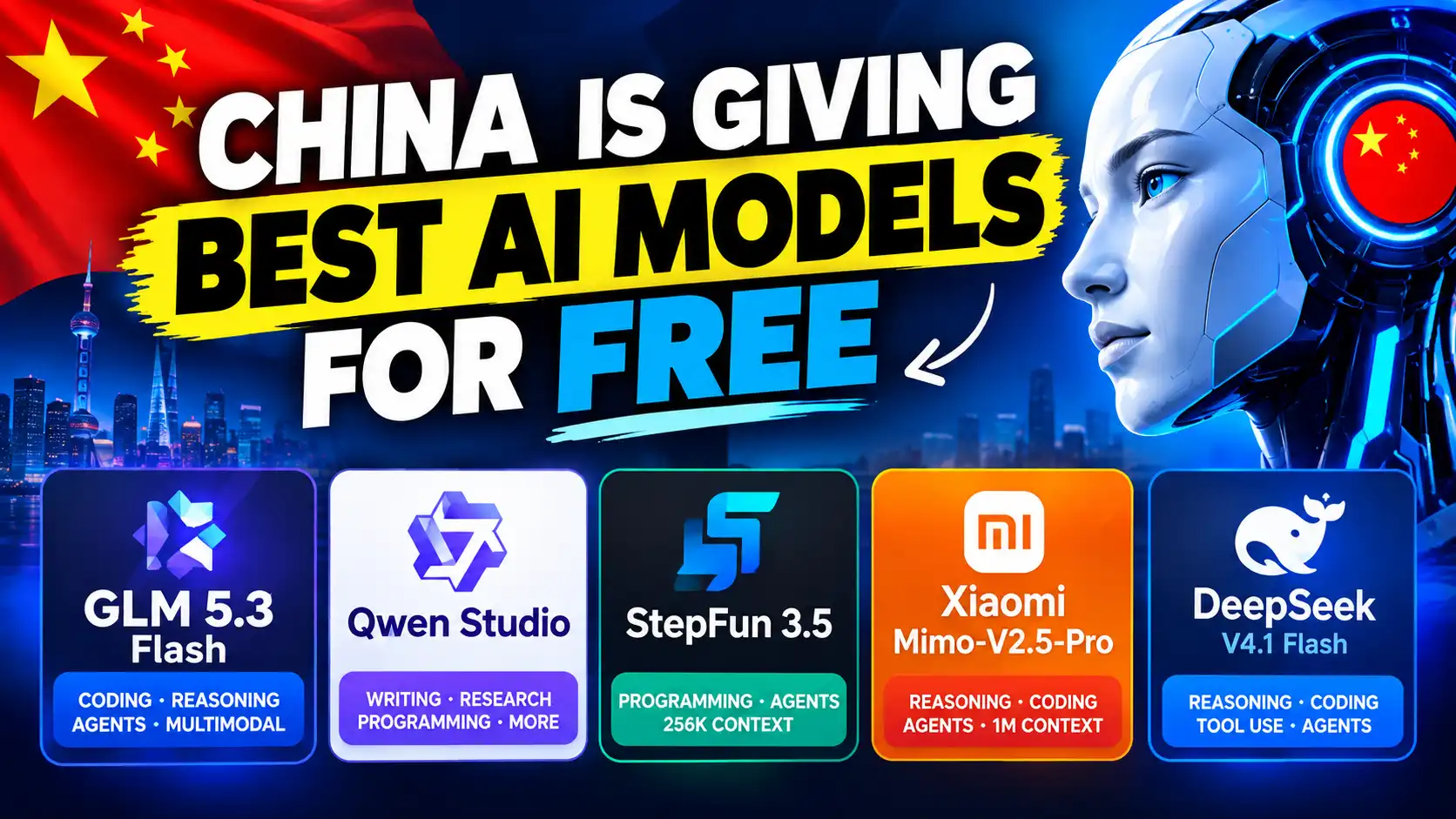
China Is Giving Some of Its Best AI Models for Free
From reasoning and programming to AI agents, image understanding, and long-context workflows, Chinese AI companies are rapidly building powerful alternatives to some of the biggest Western AI platforms.
The AI landscape is becoming much more competitive. While ChatGPT, Claude, and Gemini receive much of the attention, a growing number of Chinese AI companies are releasing powerful models and platforms that are available to users at little or no cost.
What's particularly interesting is the range of capabilities. Some models focus on coding and reasoning, while others are designed for agents, multimodal tasks, research, file analysis, and long-running workflows.
Here are five Chinese AI models and platforms worth knowing about if you want to explore alternatives to the most popular AI assistants.
GLM 5.3 Flash
GLM 5.3 Flash is presented as one of Zhipu AI's newer models, with an emphasis on speed, reasoning, programming, agent processing, and multimodal capabilities.
What Makes It Interesting?
- Designed for tasks involving programming, reasoning, agents, and image comprehension.
- Uses a mixture-of-experts approach in which only a portion of the total parameters are activated for an individual task.
- The architecture is designed to reduce the computational resources needed while maintaining strong performance.
That combination makes GLM 5.3 Flash particularly interesting for users who care about fast AI responses and efficient model architectures.
Qwen Studio
Qwen Studio is Alibaba's AI platform built around the Qwen family of models. Rather than focusing on just one type of task, the platform can be used across a broad range of everyday and professional AI workflows.
What Can You Use Qwen Studio For?
- Writing and content creation
- Research and information analysis
- Programming and coding assistance
- File analysis
- Image generation and multimodal tasks
- More complex AI workflows
One of the biggest advantages of a platform like Qwen Studio is the ability to access different models from the Qwen ecosystem depending on the task.
StepFun 3.5
StepFun 3.5 is another Chinese AI model attracting attention for programming, reasoning, and autonomous agent workflows.
Instead of being designed only for simple questions and answers, StepFun 3.5 is aimed at more demanding tasks that may require multiple steps and extended context.
Key Features
- Supports a 256K context window for handling large amounts of information.
- Designed for complex, multi-stage tasks and AI agents.
- Focuses heavily on programming and technical workflows.
- An open-source approach can make local deployment possible for users with sufficiently powerful hardware.
Xiaomi Mimo-V2.5-Pro
Xiaomi is also entering the increasingly competitive AI model market with Mimo-V2.5-Pro, a model aimed at reasoning, software engineering, and agentic workflows.
Built for Long-Running AI Tasks
The model is designed around workflows where an AI system needs to maintain context and consistency while completing complicated tasks over an extended period.
- Focuses on AI reasoning and programming.
- Designed for AI agents and software engineering.
- Supports very large context windows for lengthy workflows.
- Intended for tasks involving numerous tool calls and multiple stages.
These characteristics make it particularly relevant to developers and researchers experimenting with long-running agent workflows.
The DeepSeek Whale
DeepSeek has become one of the most recognizable Chinese AI names globally. Its models have attracted significant attention for reasoning, coding, tool use, and efficient AI performance.
The latest model referenced in this list is DeepSeek V4.1 Flash, which is positioned around fast responses and more advanced AI workflows.
What Can It Do?
- Advanced reasoning
- Programming and code generation
- Tool usage
- Agent-based workflows
- Image understanding
Why Chinese AI Models Matter
The rapid development of Chinese AI models is giving users more choices. Instead of relying on a small number of major AI companies, users can now experiment with different models for coding, research, reasoning, image understanding, and autonomous workflows.
Another important trend is the combination of powerful models with free access or open-source availability. This can make advanced AI capabilities easier to explore for students, developers, creators, and small businesses.
Of course, free access does not necessarily mean unlimited usage, and availability, model versions, regional access, and usage limits can change. It's worth checking the provider's current terms before relying on any particular model for important work.
Final Thoughts
China's AI ecosystem is evolving quickly, and models such as GLM, Qwen, StepFun, Xiaomi Mimo, and DeepSeek show how broad the competition has become. Whether you're interested in coding, AI agents, research, or everyday productivity, there are increasingly more models to test.
If you're building your own AI toolkit in 2026, experimenting with several models can help you understand which systems work best for different types of tasks.
Discussion (0)
No comments yet. Be the first to share your thoughts!